In a competitive Sydney property market, buyers often make decisions in 48 hours. Auctions demand unconditional bids. Agents pressure you toward quick exchange. In that environment, one thing separates buyers who get a good deal from those who inherit expensive problems: an independent pre-purchase building inspection by a licensed certifier.
This is not a tick-and-flick inspection report. This is a forensic assessment of one of the most significant financial decisions of your life.
What Is a Pre-Purchase Building Inspection?
A pre-purchase building inspection is a systematic visual assessment of a property’s structural integrity, moisture levels, and safety compliance, carried out by a qualified inspector before you exchange contracts.
In NSW, building inspections for residential dwellings must comply with Australian Standard AS 4349.1 – Inspection of Buildings. This standard defines exactly what must be assessed, what is and isn’t in scope, and how defects must be classified and reported.
Our inspectors are not just trained inspectors — they are Unrestricted Private Building Certifiers registered under NSW Fair Trading. This means we have the technical depth to identify not just cosmetic defects, but structural non-compliances, BCA violations, and moisture-related failures that standard inspectors routinely miss.
What Exactly Is Inspected?
Our inspections cover every accessible area of the property. Here is what the senior inspector assesses:
1. Roof Exterior and Ceiling Void
The roof is the most expensive component of a residential building to repair, and one of the most commonly defective.
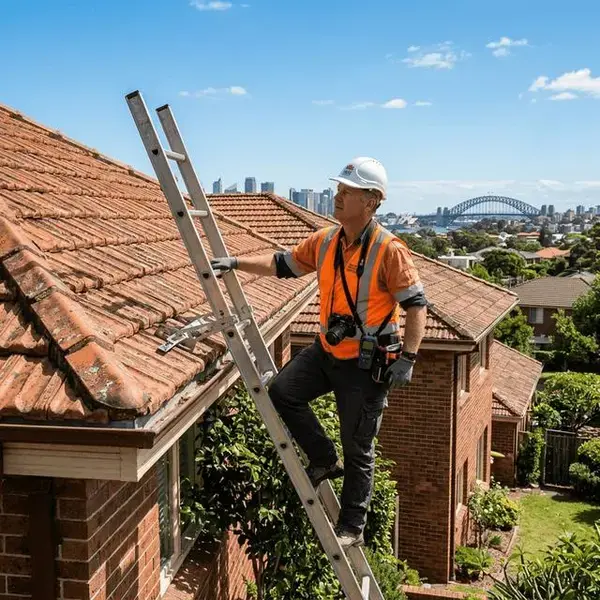
We physically climb onto the roof (where safe access exists) and crawl through the ceiling void. We check:
- Roof cladding: Cracked, displaced, or deteriorated tiles; rusting iron; missing valley flashings
- Ridge capping and pointing: Deteriorated pointing is the #1 cause of roof water ingress in older homes
- Box and fascia gutters: Blocked, sagging, or overflowing gutters cause cascading internal moisture damage
- Roof framing: Sagging, cracked, or undersized timber members visible from within the ceiling void
- Sarking and insulation: Torn sarking creates direct moisture pathways; missing or incorrectly installed insulation breaches BASIX
- Skylights: Cracked domes, failed seals, condensation between panes
A poorly maintained roof on a 1970s brick veneer home can cost $25,000–$45,000 to fully restore. We find this before you sign.
2. Subfloor Space
If the property has a subfloor void (common in older Sydney homes on timber stumps), this is where the most expensive structural problems hide.
Access is tight and dirty. Most buyers — and many cheaper inspection services — never go in. We do. We assess:
- Bearers and joists: Rot, insect damage, undersized members, modifications without support
- Brick piers: Cracking, movement, inadequate mortar, missing ant-capping
- Moisture and dampness: Standing water, high timber moisture readings, hydrostatic pressure
- Termite evidence: Mud trails, damaged timber, frass — though note our inspection is a structural inspection, not a timber pest inspection
- Ventilation: Blocked subfloor vents cause condensation buildup and accelerated timber decay
3. Internal Structure
We assess every room systematically, moving from top to bottom:
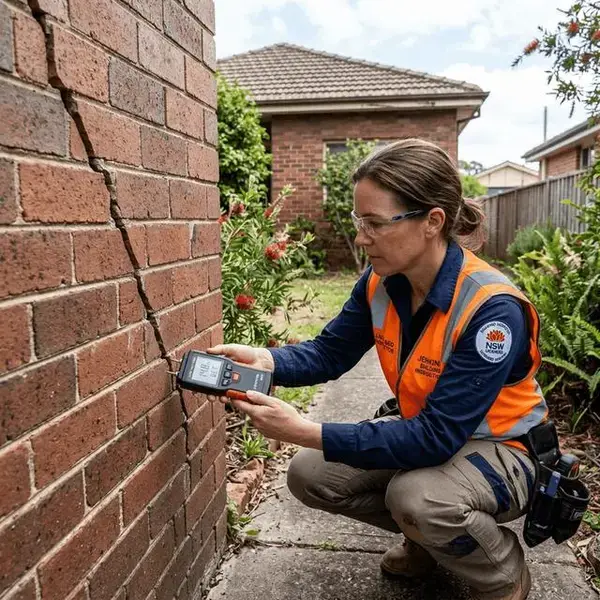
- Wall and ceiling cracking: We distinguish cosmetic hairline cracks from structural movement cracking (stair-stepped, offset, or wide cracks indicate foundation movement)
- Flooring: Sloping, bouncy, or deflecting floors indicate structural issues below
- Doors and windows: Binding or misaligned doors and windows are classic signs of building movement
- Wet areas: Drummy or cracked tiles indicate failed substrate; shower recesses are pressure-tested for waterproofing failure
- Plasterboard: Bowing, cracking, or delaminating plasterboard around wet areas indicates long-term moisture infiltration
4. Moisture and Thermal Assessment
We use calibrated digital moisture meters and, where appropriate, thermal imaging to detect moisture behind surfaces without breaking materials.
Common findings:
- Failed shower recess waterproofing membranes (the #1 source of inter-tenancy disputes in strata)
- Rising damp in masonry walls
- Condensation in wall cavities from poor vapour management
- Balcony waterproofing membrane failures creating internal ceiling staining
5. External Structure
- Brickwork and mortar: Structural cracking patterns, spalling, missing or deteriorated weep holes
- Render: Delamination (hollow render), cracking, water penetration
- Retaining walls: Overloaded, inadequate drainage, leaning, cracking
- Site drainage: Inadequate falls toward the building, pooling adjacent to foundations
- Timber elements: Fascia boards, pergola members, decking — rot, insect damage, inadequate fixings
6. Safety Hazards
We flag anything that poses an immediate risk of injury:
- Non-compliant staircases (riser height, tread depth, balustrade height)
- Missing or inadequate pool barrier compliance
- Exposed electrical wiring or outdated switchboards
- Presence of loose or friable asbestos-containing materials (we note and recommend specialist testing)
- Missing smoke alarms (legally required in all NSW dwellings since 1998)
How to Use the Inspection Report
The inspection report is not just a document to file. It is a negotiation tool and a risk-management document.
Before Auction
If you are buying at auction and want to bid unconditionally, commission the inspection before the auction date. Allow 48–72 hours for report delivery. The $600–$900 inspection fee is trivial against the risk of buying a property with $50,000 in hidden defects.
Before Exchange on Private Treaty
Include a building inspection clause in your offer: “This contract is conditional upon the buyer obtaining a satisfactory building inspection report within [5] business days of exchange.”
A building inspection clause gives you the right to withdraw from the contract (or renegotiate the price) if the report reveals major defects. Without it, you are buying the defects along with the property.
Using Defects to Negotiate
Our reports categorise defects as:
- Major defects: Structural, significant moisture damage, safety hazards — requiring immediate attention
- Minor defects: Maintenance items, cosmetic defects — typical for any property age
A report identifying $30,000 in major defects (roof restoration, subfloor moisture remediation, structural crack repair) gives you a clear negotiating position: request a price reduction equivalent to the rectification cost, or request that the vendor rectify before settlement.
Vendors who have been through this process know the report is accurate. A report from a licensed unrestricted certifier carries far more weight than one from a general home inspector.
What Is NOT Included
Under AS 4349.1, a standard building inspection is a visual inspection only. The following are out of scope unless separately contracted:
- Timber pest (termite) inspection — this requires a separately licensed timber pest inspector under AS 4349.3
- Asbestos testing — we note suspected materials; laboratory testing requires a separate sample analysis
- Electrical inspection — we note visible concerns; full electrical compliance requires a licensed electrician
- Plumbing inspection — we note visible issues; a licensed plumber tests drain function separately
- Hidden areas — inside walls, under slabs, behind built-in furniture
We strongly recommend combining a building inspection with a timber pest inspection for any property built before 1985. Both can typically be scheduled on the same day with two inspectors attending simultaneously.
What a Typical Report Looks Like
Our reports are delivered within 24 hours of the inspection in PDF format. A standard report includes:
- Executive summary with a traffic-light defect rating system
- Detailed findings for each area with written descriptions
- High-resolution photographs of every defect found (typically 50–120 photos per report)
- Recommendations for each defect (immediate action / monitor / maintenance)
- Inspector’s qualifications and registration details
Every report is signed by a qualified person. If you receive a report without a signatory’s qualifications listed, treat it with caution.
How Much Does It Cost?
A standard pre-purchase building inspection for a 3–4 bedroom house in Sydney typically costs between $550 and $950 depending on property size, age, and access complexity.
Compare this to:
- The cost of a $35,000 roof restoration discovered post-settlement
- The cost of $12,000 in subfloor moisture remediation
- The cost of $60,000 in structural crack repair and underpinning
A building inspection is not an expense. It is the cheapest insurance policy available for a property purchase.
Frequently Asked Questions
Can I attend the inspection?
Yes — and we actively encourage you to attend for the final 30 minutes. We’ll walk you through every major finding in person before you read the written report. Understanding the context of a defect in real life is far more useful than reading a description alone.
How quickly can I get an inspection?
We typically schedule inspections within 1–2 business days of booking and deliver reports within 24 hours of the inspection. For auction properties with tight timelines, contact us directly to discuss urgent scheduling.
Is the report valid if I don’t end up buying?
The inspection report is the buyer’s property. If you commission an inspection on a property and then decide not to purchase, the report is yours to keep. Some buyers use the same report to negotiate a lower price rather than withdrawing.
Do you inspect units and apartments?
Yes. For strata properties, we assess your specific lot (interior, balcony, parking space) plus accessible common areas to give you a sense of the overall building condition. We highly recommend combining this with a formal strata records search.
Book Your Pre-Purchase Inspection
Don’t let time pressure or agent urgency push you into a decision without independent expert advice. Our team of licensed, unrestricted certifiers brings a level of technical depth to pre-purchase inspections that standard inspection services cannot match.
We cover all of Sydney and surrounding regions, with same-week scheduling available in most areas.