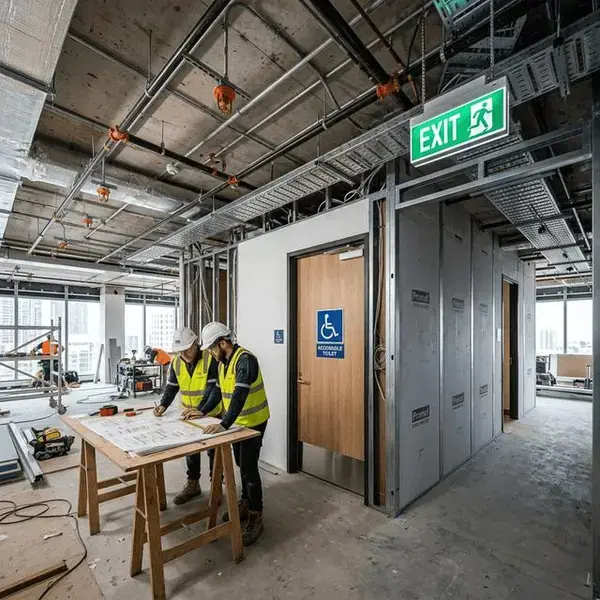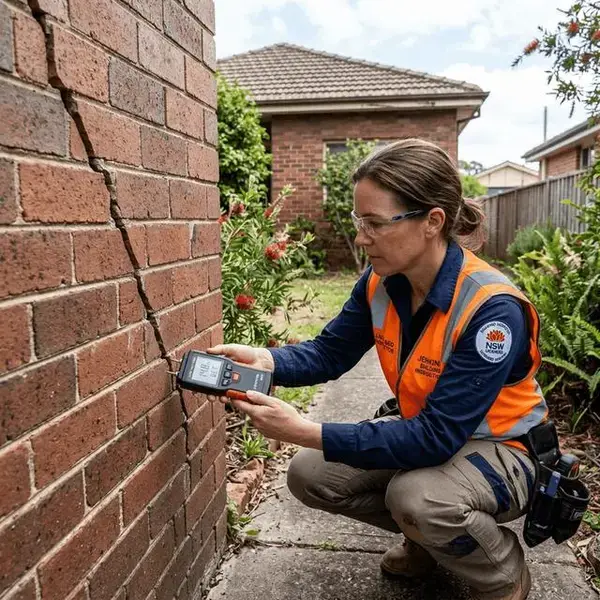
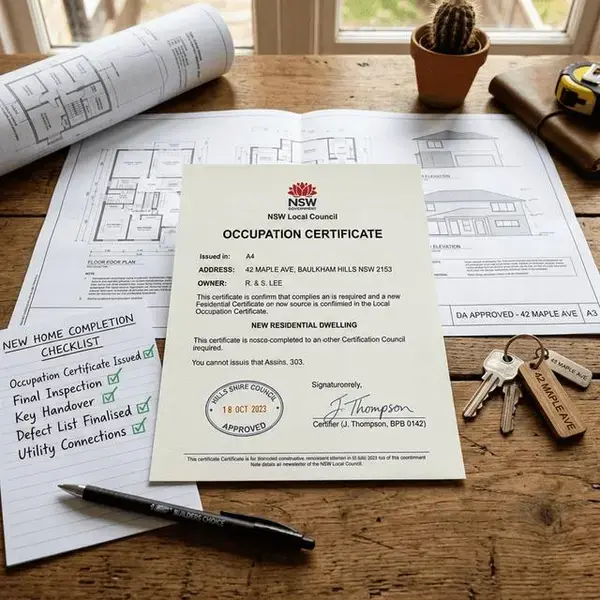
An Occupation Certificate (OC) is the legal document that allows you — or your tenants — to occupy a completed building in NSW. Without it, you cannot legally move in, settle a sale contract, or hand over a unit to a buyer. It is the final gate between construction and occupation, and it is the stage where projects most commonly stall.
The cause of most OC delays is not the certifier — it is incomplete documentation, failed inspections, or non-compliant work that surfaces only at the final stage.
This checklist exists to prevent that. Use it from Day 1 of construction, not the week before you want to move in.
Understanding the Two Types of Occupation Certificate
Before diving into the checklist, it’s important to understand which OC applies to your project.
Interim Occupation Certificate
Issued when part of a building is suitable for occupation while other parts are still under construction. Common for:
- Multi-storey residential buildings where lower floors are ready while upper floors are still being completed
- Mixed-use developments where the commercial ground floor is finished before the residential levels above
- Staged development approvals
Final Occupation Certificate
Issued when the entire building is completed and compliant. This is what most residential builders and homeowners are working toward.
In NSW, issuing an Occupation Certificate is a legal function of a Principal Certifier (PC). Only your appointed PC can issue your OC — and only after they are satisfied that the building complies with the development consent or CDC approval conditions.
The Stage-by-Stage OC Checklist
The most effective way to use this checklist is to treat it as a running document — not something you look at for the first time in the final week of construction.
Stage 1: Before Construction Starts
Get these right at the beginning to avoid late-stage surprises:
- Confirm your Principal Certifier is appointed in writing — Your PC must be appointed before any construction begins. The appointment must be lodged on the NSW Planning Portal.
- Read every condition of your CDC or DA consent — Every OC roadblock comes from a condition that was not read or not acted on. Print your consent conditions and read every line.
- Identify which mandatory inspections are required — Your PC will provide a Critical Stage Inspection (CSI) schedule. Mark these dates in your construction programme from Day 1. Missing a CSI means the work must be exposed again or a variation must be obtained.
- Check whether a BASIX certificate is required — For all NSW residential construction, BASIX commitments must be implemented and documented during construction. BASIX is checked at OC stage.
- Identify any deferred conditions — Some DAs contain conditions that must be satisfied before an OC can be issued (contributions levies, infrastructure works, landscaping). These can take weeks or months to discharge. Know them early.
- Confirm stormwater and drainage design is approved — For CDC approvals, the stormwater solution must comply with AS 3500. For DA projects, council approval of the drainage design is required.
Stage 2: During Construction
The OC is won or lost during construction, not at the end.
- Book all Critical Stage Inspections with your PC before the work is covered — Under the EP&A Act, work must be inspected before it is covered. If your PC cannot get to site in time, do not proceed with covering. This is the most common reason for OC delays in residential construction.
- Do not vary from the approved plans without approval — Any departure from the approved architectural or structural drawings that is not a minor modification requires a formal Section 4.55 modification (for DA projects) or an amended CDC. Variations that are not approved cannot be signed off at OC stage.
- Keep all Critical Stage Inspection records — Every CSI must be documented. Your PC will retain records, but you should also keep your own set. Inspect certificates must reference the specific stage and be date-stamped.
- Collect all statutory compliance certificates as work is completed:
- Waterproofing inspection certificate (shower recesses, balconies, wet areas)
- Termite barrier certificate (physical barrier or chemical treatment, with written warranty)
- Smoke alarm compliance certificate
- Pool barrier compliance certificate (if applicable)
- Energy efficiency compliance: insulation installation certificate, glazing specifications
- Structural engineer’s certificate (confirming frame, slab, and footings comply with the approved structural design)
- Photograph BASIX items as they are installed — BASIX commitments such as solar hot water, rainwater tanks, insulation R-values, and window glazing must be evidenced at OC stage. Photographs with timestamps are the most efficient way to do this.
- Monitor drainage installation — Drainage that doesn’t comply with AS 3500 or the approved drainage design is one of the most common OC failures. Have your plumber provide a compliance certificate.
Stage 3: Approaching Practical Completion
The final 4–6 weeks before OC application — where most projects get into trouble.
- Commission a Pre-OC Inspection (Practical Completion Inspection) — A thorough walk-through by an independent certifier 3–4 weeks before your target OC date will identify every outstanding compliance item. This is far cheaper than discovering issues at final OC stage when trades have demobilised.
- Obtain all outstanding compliance certificates before applying for OC:
- Council Section 73 Certificate (Sydney Water approval of water and sewer) — allow 4–6 weeks
- Plumbing and drainage inspection certificate
- QCAT/fire safety certificate (where applicable for Class 2–9 buildings)
- Asbestos clearance certificate (for renovation projects involving ACMs)
- Check that all landscaping conditions from the consent are satisfied — Development consents commonly require landscaping to be substantially complete before OC. This is frequently missed.
- Confirm all development contributions have been paid — Section 7.11 contributions must be paid before a council issues a Subdivision Certificate, which may be a prerequisite for your OC. Check your consent conditions.
- Ensure the building is clearly numbered — Under AS 1428, the property address must be displayed on the building in a compliant format. Certifiers will not issue an OC without visible numbering.
- Test all smoke alarms and emergency lighting — These must be tested and functional at OC stage. A certificate from a licensed electrician is required.
- Confirm all waterproofing membranes are certified — Every wet area and balcony must have a waterproofing compliance certificate from a licensed waterproofer, confirming the membrane was installed in accordance with AS 3740.
Stage 4: The OC Application
- Lodge the OC application with your PC with a complete documentation package:
- Completed and signed OC application form
- Copy of the approved plans (CDC or DA stamped set)
- All Critical Stage Inspection records
- All statutory compliance certificates listed above
- BASIX completion checklist (signed by the builder and owner)
- Structural engineer’s certification
- Fire safety schedule (if applicable)
- Conduct a final joint inspection with your PC — This is your final opportunity to walk through with your certifier and identify any outstanding items before the formal OC decision is made.
- Respond to any PC queries within 48 hours — Delays in responding to certifier requests for additional information are the single most avoidable cause of OC timing blowouts.
The 7 Most Common OC Roadblocks (and How to Avoid Them)
1. Missing waterproofing certificates
Problem: Wet area waterproofing was inspected but the certificate was never collected from the waterproofer.
Fix: Add collection of waterproofing certificates to your construction superintendent’s weekly checklist. Collect them immediately after the inspection, not at the end of the build.
2. Unapproved variations
Problem: The builder changed the window configuration, relocated a door, or modified a structural element without obtaining a formal variation. The as-built drawings don’t match the approved plans.
Fix: Any variation from the approved drawings must be captured in writing before the work is done. If in doubt, call your certifier.
3. Sydney Water Section 73 certificate delayed
Problem: The Section 73 process was not started until late in construction. It routinely takes 4–6 weeks.
Fix: Lodge the Section 73 application no later than the frame inspection stage. Do not leave this until you are ready to occupy.
4. BASIX commitments not fully implemented
Problem: The BASIX certificate required a 5,000L rainwater tank plumbed to the laundry and toilets. The builder installed the tank but did not plumb it to the laundry.
Fix: Print your BASIX commitments schedule and check off each item physically on site before applying for OC.
5. Landscaping not completed
Problem: The DA consent required a minimum of 20% of the site to be deep soil landscaping with specified species. Construction waste is still on the land at OC stage.
Fix: Identify landscaping conditions in the consent as early as possible. Engage a landscape contractor to complete this at least 4 weeks before your OC target date to allow for any defects or replanting.
6. Pool barrier non-compliance
Problem: The pool barrier has a climbable object within the exclusion zone or gate does not self-close and latch correctly.
Fix: Commission a pool barrier compliance inspection at least 4 weeks before OC. Any remedial work can then be completed and re-inspected in time.
7. Fire safety schedule incomplete (Class 2–9 buildings)
Problem: The building requires a fire safety certificate but the inspection and certification of fire safety measures was not completed before OC application.
Fix: Engage a fire safety inspector early. For commercial and multi-residential buildings, the fire safety schedule must be lodged with council before the OC is issued.
How Long Does It Take to Get an OC?
Once a complete and compliant documentation package is submitted to your Principal Certifier, an OC can typically be issued within 5–10 business days for residential projects.
The process is longer for:
- Class 2 buildings (apartments): 15–30 business days after all certificates are in order
- Mixed-use or commercial developments: subject to fire safety schedule and council lodgement
The OC timeline is entirely within your control. If you start collecting compliance certificates from Day 1 of construction, the OC application process is straightforward. If you start chasing certificates in the final week, expect delays.
Frequently Asked Questions
Can I move in before the OC is issued?
No. It is illegal to occupy a building in NSW without an Occupation Certificate. Fines apply to both the owner and the occupier. Your builder cannot give you the keys and you cannot hand over to a buyer at settlement without a valid OC.
What happens if work was done without approval?
If unapproved work is discovered during the OC process, you have two options: obtain a retrospective approval (where possible) or remove and redo the non-compliant work. Neither is quick or cheap. Prevention is the only effective strategy.
Can I transfer my Principal Certifier?
Yes, a PC can be changed during construction. However, the new PC must be satisfied with the inspection records from the previous PC. Changing certifiers mid-construction can cause delays if records are incomplete.
Do I need an OC if I have a CDC?
Yes. A CDC is an approval to carry out construction. An Occupation Certificate is the sign-off that the construction has been completed in accordance with that approval. Both are required.
Work With a Certifier From Day 1
The most effective way to avoid OC roadblocks is to appoint your Principal Certifier before construction begins and maintain regular communication throughout. Your PC is not just the person who signs off at the end — they are your compliance partner for the entire construction programme.
No1 Building Services acts as Principal Certifier for residential and commercial projects across all of NSW, with a track record of smooth OC approvals for builders, developers, and owner-builders alike.